Published
-
2026-05-29 US legal friction, slowing growth, and AI spending move in parallel

Photo by Blogging Guide on Unsplash
2026-05-29 US legal friction, slowing growth, and AI spending move in parallel
In the last 24-48 hours, US politics kept colliding with courts, macro data showed slower growth with sticky price pressure, and major tech firms pushed AI features and safety controls forward at the same time.
Politics
Kennedy Center name dispute paused
A federal judge blocked the Kennedy Center move, forcing the Trump team to step back.
What happened: A federal judge said adding Trump’s name to the Kennedy Center was unlawful and blocked the planned two-year closure for renovations. Trump then signaled he would back off, shifting the fight back into the courts.
Why it matters: A cultural venue has become a test case for symbolic politics and executive power. The ruling also shows how quickly policy theater can turn into legal resistance.
What to watch next: Appeals, name-removal steps, and whether the renovation plan gets rewritten.
Mail voting order faces a first hurdle
A judge refused to immediately stop the executive order aimed at mail voting and federal voter lists.
What happened: A federal judge declined to block the order that would tighten mail voting and create a federal voter list. The legal and operational fight over election administration is now underway.
Why it matters: Election rules are being pushed toward federal redesign. If implementation moves ahead, state-level conflicts and litigation could accelerate quickly.
What to watch next: Additional lawsuits, state responses, and how detailed the new guidance becomes.
New Hampshire citizenship proof ruling
The court kept an affidavit fallback for voters who do not have the required documents.
What happened: A federal court told New Hampshire to preserve affidavit-based voting for people who lack documents. The ruling slows a harder proof-of-citizenship approach.
Why it matters: States are still drawing the line between access and anti-fraud rules. This case is likely to be cited by other election-law fights.
What to watch next: Whether the state appeals and whether similar requirements spread elsewhere.
Putin signals more pressure on Ukraine
AP reported that Russia may be preparing another major wave of strikes on Kyiv.
What happened: AP said Russia may be preparing another major attack wave on Kyiv. With no real breakthrough in talks, military pressure is rising again.
Why it matters: The war keeps feeding into security policy, sanctions, and energy prices. This is not just a battlefield story; it is also a macro and diplomacy story.
What to watch next: Drone and missile volume, any new Western aid, and whether ceasefire talks change tone.
Drone strikes on Russian oil infrastructure
Ukraine kept striking Russian oil infrastructure while bracing for retaliation.
What happened: Ukraine kept targeting Russian oil sites while preparing for broader retaliation. The front line is now directly hitting fuel supply and export revenue.
Why it matters: These strikes affect both military attrition and the Russian economy, while also pressuring global oil markets.
What to watch next: Whether retaliation widens and whether refined-product flows get disrupted.
Economy
Q1 GDP revised lower

BEA revised down first-quarter US GDP growth in its second estimate.
What happened: BEA lowered its second estimate for first-quarter GDP, showing the economy was weaker than the initial print suggested. Investment and consumer spending were less robust than expected.
Why it matters: A downward revision does not mean recession, but it does make slowing momentum more explicit. That matters for both corporate planning and policy expectations.
What to watch next: Whether jobs, spending, and inventory data in June confirm the slowdown.
Personal income still supports demand
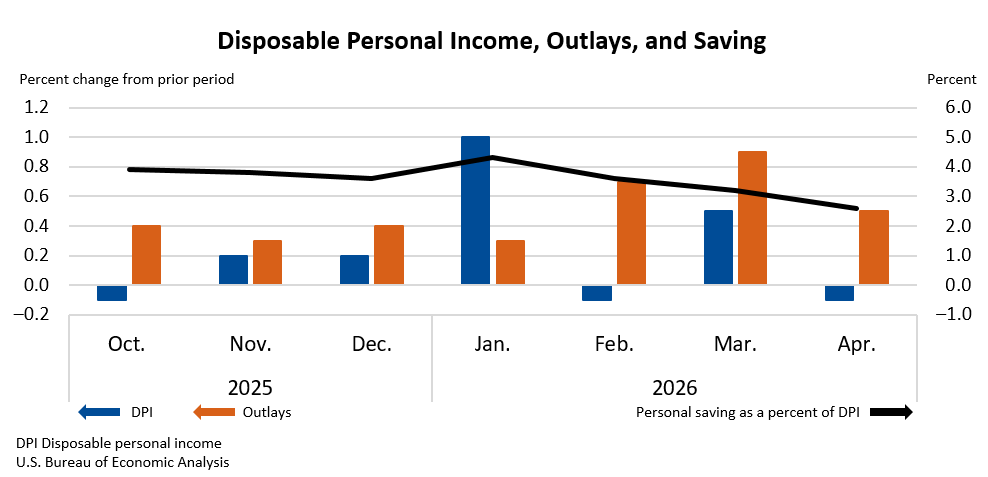
April income and PCE data showed resilient demand and persistent price pressure.
What happened: April income and spending data showed consumers had not suddenly pulled back. The PCE price index also kept moving higher on the month.
Why it matters: Resilient demand keeps the economy from rolling over, but it also makes rate cuts harder to justify. Markets are left with a “slower, but not cleanly disinflating” picture.
What to watch next: The next jobs report and the follow-up PCE release.
Stocks keep chasing records on earnings and AI
Earnings strength and AI expectations kept pushing US equities higher.
What happened: AP reported that strong corporate earnings and AI optimism pushed US stocks back toward record levels. Even with rate uncertainty, earnings growth kept risk assets bid.
Why it matters: Markets are balancing slowing growth against resilient profits. Near-term volatility is still being overridden by earnings and AI capex expectations.
What to watch next: How rates and oil affect valuation multiples into the back half of earnings season.
Lower oil prices ease inflation pressure
Lower oil prices helped reduce inflation pressure and supported risk assets.
What happened: Falling oil prices helped stocks and other risk assets, while easing fears of a fresh inflation spike. Energy-sensitive sectors got some relief.
Why it matters: Oil still has a direct line into inflation, transport costs, and consumer sentiment. A short-lived oil move can change the macro narrative quickly.
What to watch next: Whether Middle East tensions and futures markets reverse the calm.
FOMC minutes keep the inflation warning active

The minutes kept the focus on sticky inflation, energy risk, and a still-resilient economy.
What happened: The minutes showed officials still worried about inflation and energy-related uncertainty even as the economy held up. The tone remained cautious rather than eager to cut.
Why it matters: Markets cannot rely on a simple “slowing growth means easier policy” story. Tariffs, energy, and inflation persistence keep the policy path murkier.
What to watch next: The next round of jobs and price data before the next meeting.
Technology
Rosalind Biodefense
OpenAI pointed researchers toward GPT-Rosalind access and support for new biodefense capabilities.
What happened: OpenAI introduced access and sponsorship paths around GPT-Rosalind in a biodefense context. The announcement put high-risk scientific use cases in the spotlight.
Why it matters: Generative AI is moving further into research and security-sensitive domains, not just office productivity. Access control and auditability matter more as the use case gets riskier.
What to watch next: Who gets access, under what conditions, and how much safety control is made public.
Project Lightwell

IBM and Red Hat announced a major push to reinforce open-source infrastructure for AI.
What happened: IBM and Red Hat announced a major investment in open-source infrastructure for the AI era and framed it as Project Lightwell. The goal is tighter control over the software supply chain behind enterprise AI.
Why it matters: Competitive advantage now depends on more than the model itself. Validation, dependencies, and distribution infrastructure have become strategic assets.
What to watch next: Which developer-facing features ship first, and where the money flows in the open-source stack.
Google I/O 2026 roundup

Google bundled Gemini, Search, Android, and agentic updates into one I/O roundup.
What happened: Google collected its I/O 2026 announcements and pushed Gemini, Search, Android, and agent-style features to the front. The company is clearly moving from model competition to product-wide AI integration.
Why it matters: The platform race is shifting from model quality to end-to-end AI product design. Search and mobile experiences are being reworked around AI.
What to watch next: General availability, API access, and how much day-to-day search and device behavior actually changes.
Android Show: I/O Edition

Google previewed a Gemini-centered update to Android.
What happened: Google used Android Show to preview a more Gemini-centered Android experience. The update extends AI into daily device use, not just search or browser workflows.
Why it matters: Mobile OS differentiation is moving from hardware and UI polish toward practical AI assistant behavior. Android is trying to make that experience standard across its ecosystem.
What to watch next: Device support, language coverage, and how tightly the new features hook into existing Google apps.
PraisonAI vulnerability cluster

On May 29, a cluster of high-risk PraisonAI advisories highlighted the need to review AI workflow infrastructure.
What happened: GitHub’s Advisory Database surfaced multiple critical/high advisories around PraisonAI Platform, drawing attention to AI workflow infrastructure. This is a stack-level hygiene issue, not just a single CVE.
Why it matters: As AI agents and workflow automation spread, the security of surrounding platforms and permissions becomes as important as the model itself. Weak dependencies can spread from test environments into production.
What to watch next: Additional reports, patch timing, and whether enterprises actually update the affected dependencies.
Cross-cutting view
- Legal friction is now shaping policy implementation across cultural institutions and election rules.
- Growth is slowing, but inflation has not clearly broken, which keeps rate-cut assumptions fragile.
- Markets are being supported by profits and AI spending even as oil and geopolitics can still reprice inflation quickly.
- Tech announcements are moving together with safety and governance work, especially in biotech and vulnerability management.
- The common thread is a tug-of-war between expanding AI capability and the institutions trying to contain its side effects.
Unresolved items to track
- Whether the Kennedy Center and mail-voting fights change materially on appeal.
- Whether the Ukraine war’s oil-infrastructure strikes begin to show up in energy markets.
- Whether weaker GDP and sticky PCE continue into the next round of data.
- Whether Google, OpenAI, and IBM ship these announcements broadly or keep them limited.
- Whether the GitHub advisories are the first sign of a broader AI-workflow security cleanup.
2026-05-29 米政局の司法摩擦、景気鈍化、AI投資が並走
直近24〜48時間は、米国の政局と司法のせめぎ合いが続く一方で、景気指標は減速と粘着的な物価圧力を示し、各社はAI機能と安全対策を相次いで前に出した。
政治
ケネディ・センター名義差し止め
連邦地裁はケネディ・センター改修と名称表示を巡るトランプ氏の動きを差し止め、政権は一歩引いた。
何が起きたか: 連邦地裁は、トランプ氏の名前をケネディ・センター外壁に加えたのは違法で、改修のための2年閉鎖も差し止めた。トランプ氏は強硬策を抑える姿勢に転じ、争点は司法の場に移った。
なぜ重要か: 文化施設を巡る問題が、象徴政治と権限争いのケーススタディになっている。行政の象徴操作が裁判所で止められるかどうかは、今後の文化政策にも波及する。
今後の注視点: 控訴の有無と、名称表示や改修計画が実際に修正されるかを確認したい。
郵便投票規制の初期関門
連邦判事は、郵便投票を制限し連邦有権者名簿を作る大統領令の即時差し止めを見送った。
何が起きたか: 連邦判事は、トランプ氏の大統領令を差し止めるよう求めた訴えを退け、まずは実施を止めない判断を下した。郵便投票と有権者名簿の扱いを巡る法廷闘争は、これから本格化する。
なぜ重要か: 選挙制度の細部が、連邦レベルで再設計されるかどうかの入口に来ている。実施が進めば、州ごとの運用差や訴訟件数が一気に増える可能性がある。
今後の注視点: 州政府と連邦政府の追加提訴、そして実務指針がどこまで具体化するかを追いたい。
ニューハンプシャーの誓約証明
書類がない有権者にも宣誓供述を認めるよう命じ、州の証明義務を一部緩めた。
何が起きたか: ニューハンプシャー州の証明書類要件を巡り、連邦地裁は、書類が不足する有権者にも宣誓供述で対応できる余地を残すよう求めた。選挙権確認を厳格化する流れに、一定のブレーキがかかった。
なぜ重要か: 州単位の証明要件は、投票アクセスと選挙不正防止のバランスをどこに置くかを象徴している。ここでの判断は、他州の制度設計にも参照されやすい。
今後の注視点: 州政府がどこまで上訴するか、今後の選挙サイクルで同様の要件が広がるかを見たい。
プーチン氏、対ウクライナ攻勢拡大の構え
ロシアがウクライナ首都への攻撃をさらに広げる構えを見せているとAPが伝えた。
何が起きたか: APは、ロシアがキエフに対する大規模攻撃を新たに準備している可能性を報じた。停戦交渉が進まない中で、軍事的圧力を強めるシグナルが出ている。
なぜ重要か: 戦況の悪化は、欧州の安全保障だけでなく、エネルギー価格や制裁政策にも波及する。政治ニュースで終わらず、市場と外交の前提条件を変える材料だ。
今後の注視点: ドローン・ミサイル攻撃の規模、米欧の追加支援、停戦交渉の温度感を追う必要がある。
ロシア石油施設へのドローン攻撃
ウクライナがロシアの石油インフラを狙った攻撃を続け、報復の拡大に備えている。
何が起きたか: ウクライナはロシアの石油関連施設への打撃を続け、ロシア側の攻撃拡大に備えている。前線の攻防が、燃料供給網と輸出収入に直接触れている。
なぜ重要か: 石油施設への攻撃は、軍事的な消耗戦であると同時に、ロシア経済と世界の原油市場への圧力でもある。戦争の経済コストが見えやすい局面だ。
今後の注視点: 露側の報復対象がどこまで広がるか、原油・精製品の流通にどんな遅れが出るかを確認したい。
経済
Q1 GDP下方修正
米商務省BEAが1Q GDPの2次推計を公表し、成長率は初値から下方修正された。
何が起きたか: BEAは2026年1〜3月期のGDPを2次推計で下方修正し、成長の勢いが初値より弱かったことを示した。設備投資や消費の伸びが想定より鈍く、景気の足取りが軽くない。
なぜ重要か: 成長率の修正は、景気後退ではなくても「勢いの鈍化」を明確にする。企業の投資計画と金融政策の見通しは、こうした修正で変わりやすい。
今後の注視点: 6月以降の雇用、消費、在庫統計がこの減速を一時的なものにとどめるかを見たい。
個人消費はなお底堅い
4月の個人所得とPCEが公表され、消費は粘る一方で物価圧力も残る構図が見えた。
何が起きたか: 4月の個人所得と支出は、需要が急失速していないことを示した。とくにPCE物価指数は月次で上昇し、インフレのしぶとさが残った。
なぜ重要か: 消費が底堅いままだと、景気は持ちこたえる一方で利下げ余地は広がりにくい。市場は「景気は悪化しないが、物価も下がり切らない」状態を織り込みやすくなる。
今後の注視点: 次の雇用統計とPCEの連続性を見て、減速とインフレのどちらが先に崩れるかを確認したい。
株高は利益とAI期待が支える
米企業利益とAI期待が株高を支え、主要指数が再び高値圏を試した。
何が起きたか: APは、企業決算の上振れとAI関連の期待が米株の高値更新を後押ししたと伝えた。金利見通しが揺れる中でも、利益成長への期待が相場を押し上げている。
なぜ重要か: 株式市場は景気減速のサインと企業利益の持ちこたえを同時に評価している。短期のボラティリティよりも、利益見通しが株価の主因になっている。
今後の注視点: 金利と原油の動きが、決算シーズン後半のバリュエーションにどう響くかを見たい。
原油安でリスク資産が支えられる
原油価格の低下がインフレ懸念を和らげ、株式市場を下支えした。
何が起きたか: 原油安が続き、株式とエネルギー関連の動きに温度差が出た。APは、インフレ再加速への警戒がやや和らいだと伝えている。
なぜ重要か: 原油は輸送、消費者物価、航空・運輸の採算に広く効く。短期的な株高と、インフレ圧力の緩和が同時に進むかが焦点だ。
今後の注視点: 中東情勢と原油先物の反発が、今回の落ち着きをすぐ崩さないかを確認したい。
FOMC議事要旨はインフレ警戒継続
FOMC議事要旨は、景気の底堅さと高いインフレ、エネルギー価格の不確実性を示した。
何が起きたか: 議事要旨では、景気はなお持ちこたえている一方、インフレやエネルギー価格に対する警戒が残っていることが確認された。利下げを急ぐ空気より、様子見を優先する姿勢が読める。
なぜ重要か: 金融市場は「成長鈍化なら利下げ」という単純な読みを置きにくい。インフレとエネルギー、関税の波及が重なると、政策判断はもっと遅くなる。
今後の注視点: 次回会合までの物価指標と雇用指標が、議事要旨の慎重姿勢を強めるかどうかを見る。
技術
Rosalind Biodefense
OpenAIは、GPT-Rosalindへのアクセス申請と新しいバイオ防衛機能の支援募集を案内した。
何が起きたか: OpenAIは、Rosalind Biodefenseの文脈でGPT-Rosalindへのアクセス申請と支援プログラムを案内した。生成AIをバイオ防衛の用途にどう閉じ込めるか、という論点が前面に出た。
なぜ重要か: 生成AIの実務利用が、一般的な業務支援から、より高リスクの研究・安全保障領域へ広がっている。機能追加と同時に、アクセス管理や監査設計が重みを増す。
今後の注視点: 誰がどの条件で利用できるのか、そしてモデル出力の安全制御がどこまで公開されるかが焦点になる。
Project Lightwell
IBMとRed Hatが、AI時代のオープンソース基盤を再定義する大型投資を発表した。
何が起きたか: IBMとRed Hatは、AI時代のオープンソース基盤を強化する大型投資とProject Lightwellを打ち出した。企業向けAIを支えるソフトウェア供給網を、より厳密に管理する狙いが見える。
なぜ重要か: AIモデルそのものだけでなく、依存ライブラリ、検証、配布の仕組みが競争力になる。オープンソースを使う企業ほど、基盤整備の価値が高まる。
今後の注視点: 具体的な開発者向け機能と、どのオープンソース領域に資金が流れるかを追いたい。
Google I/O 2026の全体像
GoogleはI/O 2026で、Gemini、検索、Android、AIエージェント関連の更新をまとめて示した。
何が起きたか: GoogleはI/O 2026の発表を集約し、検索、Gemini、Android、エージェント機能の更新を前面に出した。単発の新機能より、各プロダクトをAIで束ねる設計思想が目立つ。
なぜ重要か: 大手プラットフォームは、モデル競争から、プロダクト全体のAI統合競争へ移っている。検索やモバイルOSの体験そのものが、AIで再設計されつつある。
今後の注視点: 実際の一般提供時期、APIの開放範囲、そして検索結果や端末機能の変化幅を確認したい。
Android ShowのGemini強化
GoogleはAndroid Showで、Geminiを軸にしたAndroid体験の更新を予告した。
何が起きたか: GoogleはAndroid Showで、Geminiを中心に据えたAndroidの新しい見せ方を提示した。端末内のAI機能を、検索やブラウザだけでなく日常操作にまで広げる流れが明確になった。
なぜ重要か: モバイルOSの差別化軸が、カメラやUIから、AIアシスタントの実用性へ移っている。Androidは配布先の広さを武器に、AI体験の標準化を狙っている。
今後の注視点: 対応端末の範囲、言語対応、そして既存のGoogleアプリとの連携深度を見たい。
PraisonAI周辺の重大脆弱性
5月29日にはPraisonAI Platform関連の高リスク脆弱性が複数並び、AI開発基盤の棚卸しが迫られた。
何が起きたか: GitHub Advisory Databaseでは、PraisonAI Platform関連のcritical/highアドバイザリがまとまって公開され、AIワークフロー基盤の脆弱性が目立った。単体のCVEではなく、開発スタック全体の点検が必要な局面だ。
なぜ重要か: AIエージェントやワークフロー自動化の普及で、モデルの安全性だけでなく周辺プラットフォームの権限設計が重要になっている。脆弱な依存関係は、実験環境から本番まで一気に波及する。
今後の注視点: 影響を受けるパッケージの追加報告、修正版の公開速度、そして企業側の依存関係更新がどこまで進むかを追いたい。
横断的な見立て
- 司法と行政の摩擦は、文化施設や投票制度のような個別論点でも、連邦レベルの権限争いとして表面化している。
- 景気はまだ崩れていないが、GDPの下方修正とPCEの粘着性が示す通り、成長鈍化とインフレ残存が同時に進んでいる。
- 株式市場は利益とAI期待で高値圏を維持している一方、原油と中東情勢が再びインフレの上振れ要因として残る。
- 技術面では、AI機能の大型発表と同時に、バイオ防衛や脆弱性管理のような安全側の投資が増えている。
- 15本全体を通すと、「AIを増やす力」と「制度・安全・物価を抑える力」が同時に強まっているのが今の地合いだ。
追跡すべき未確定事項
- ケネディ・センター名義問題と郵便投票規制は、控訴でどこまで修正されるか。
- ウクライナ戦争は、ロシアの報復拡大と石油インフラへの打撃がどこまで市場に波及するか。
- GDPとPCEの弱さが一時要因か、次回の雇用・物価統計でも続くか。
- Google、OpenAI、IBMの発表は、一般提供と企業導入のどちらが先に進むか。
- GitHubの脆弱性群は、PraisonAIに限らずAIワークフロー基盤全体の見直しに波及するか。