Published
-
2026-05-29 US legal friction, slowing growth, and AI spending move in parallel

Photo by Blogging Guide on Unsplash
2026-05-29 US legal friction, slowing growth, and AI spending move in parallel
In the last 24-48 hours, US politics kept colliding with courts, macro data showed slower growth with sticky price pressure, and major tech firms pushed AI features and safety controls forward at the same time.
Politics
Kennedy Center name dispute paused
A federal judge blocked the Kennedy Center move, forcing the Trump team to step back.
What happened: A federal judge said adding Trump’s name to the Kennedy Center was unlawful and blocked the planned two-year closure for renovations. Trump then signaled he would back off, shifting the fight back into the courts.
Why it matters: A cultural venue has become a test case for symbolic politics and executive power. The ruling also shows how quickly policy theater can turn into legal resistance.
What to watch next: Appeals, name-removal steps, and whether the renovation plan gets rewritten.
Mail voting order faces a first hurdle
A judge refused to immediately stop the executive order aimed at mail voting and federal voter lists.
What happened: A federal judge declined to block the order that would tighten mail voting and create a federal voter list. The legal and operational fight over election administration is now underway.
Why it matters: Election rules are being pushed toward federal redesign. If implementation moves ahead, state-level conflicts and litigation could accelerate quickly.
What to watch next: Additional lawsuits, state responses, and how detailed the new guidance becomes.
New Hampshire citizenship proof ruling
The court kept an affidavit fallback for voters who do not have the required documents.
What happened: A federal court told New Hampshire to preserve affidavit-based voting for people who lack documents. The ruling slows a harder proof-of-citizenship approach.
Why it matters: States are still drawing the line between access and anti-fraud rules. This case is likely to be cited by other election-law fights.
What to watch next: Whether the state appeals and whether similar requirements spread elsewhere.
Putin signals more pressure on Ukraine
AP reported that Russia may be preparing another major wave of strikes on Kyiv.
What happened: AP said Russia may be preparing another major attack wave on Kyiv. With no real breakthrough in talks, military pressure is rising again.
Why it matters: The war keeps feeding into security policy, sanctions, and energy prices. This is not just a battlefield story; it is also a macro and diplomacy story.
What to watch next: Drone and missile volume, any new Western aid, and whether ceasefire talks change tone.
Drone strikes on Russian oil infrastructure
Ukraine kept striking Russian oil infrastructure while bracing for retaliation.
What happened: Ukraine kept targeting Russian oil sites while preparing for broader retaliation. The front line is now directly hitting fuel supply and export revenue.
Why it matters: These strikes affect both military attrition and the Russian economy, while also pressuring global oil markets.
What to watch next: Whether retaliation widens and whether refined-product flows get disrupted.
Economy
Q1 GDP revised lower

BEA revised down first-quarter US GDP growth in its second estimate.
What happened: BEA lowered its second estimate for first-quarter GDP, showing the economy was weaker than the initial print suggested. Investment and consumer spending were less robust than expected.
Why it matters: A downward revision does not mean recession, but it does make slowing momentum more explicit. That matters for both corporate planning and policy expectations.
What to watch next: Whether jobs, spending, and inventory data in June confirm the slowdown.
Personal income still supports demand
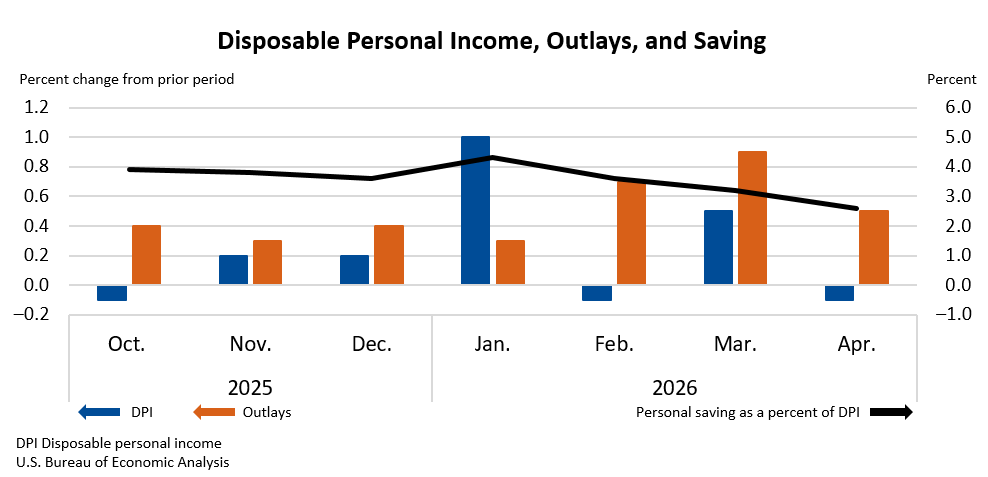
April income and PCE data showed resilient demand and persistent price pressure.
What happened: April income and spending data showed consumers had not suddenly pulled back. The PCE price index also kept moving higher on the month.
Why it matters: Resilient demand keeps the economy from rolling over, but it also makes rate cuts harder to justify. Markets are left with a “slower, but not cleanly disinflating” picture.
What to watch next: The next jobs report and the follow-up PCE release.
Stocks keep chasing records on earnings and AI
Earnings strength and AI expectations kept pushing US equities higher.
What happened: AP reported that strong corporate earnings and AI optimism pushed US stocks back toward record levels. Even with rate uncertainty, earnings growth kept risk assets bid.
Why it matters: Markets are balancing slowing growth against resilient profits. Near-term volatility is still being overridden by earnings and AI capex expectations.
What to watch next: How rates and oil affect valuation multiples into the back half of earnings season.
Lower oil prices ease inflation pressure
Lower oil prices helped reduce inflation pressure and supported risk assets.
What happened: Falling oil prices helped stocks and other risk assets, while easing fears of a fresh inflation spike. Energy-sensitive sectors got some relief.
Why it matters: Oil still has a direct line into inflation, transport costs, and consumer sentiment. A short-lived oil move can change the macro narrative quickly.
What to watch next: Whether Middle East tensions and futures markets reverse the calm.
FOMC minutes keep the inflation warning active

The minutes kept the focus on sticky inflation, energy risk, and a still-resilient economy.
What happened: The minutes showed officials still worried about inflation and energy-related uncertainty even as the economy held up. The tone remained cautious rather than eager to cut.
Why it matters: Markets cannot rely on a simple “slowing growth means easier policy” story. Tariffs, energy, and inflation persistence keep the policy path murkier.
What to watch next: The next round of jobs and price data before the next meeting.
Technology
Rosalind Biodefense
OpenAI pointed researchers toward GPT-Rosalind access and support for new biodefense capabilities.
What happened: OpenAI introduced access and sponsorship paths around GPT-Rosalind in a biodefense context. The announcement put high-risk scientific use cases in the spotlight.
Why it matters: Generative AI is moving further into research and security-sensitive domains, not just office productivity. Access control and auditability matter more as the use case gets riskier.
What to watch next: Who gets access, under what conditions, and how much safety control is made public.
Project Lightwell

IBM and Red Hat announced a major push to reinforce open-source infrastructure for AI.
What happened: IBM and Red Hat announced a major investment in open-source infrastructure for the AI era and framed it as Project Lightwell. The goal is tighter control over the software supply chain behind enterprise AI.
Why it matters: Competitive advantage now depends on more than the model itself. Validation, dependencies, and distribution infrastructure have become strategic assets.
What to watch next: Which developer-facing features ship first, and where the money flows in the open-source stack.
Google I/O 2026 roundup
Google bundled Gemini, Search, Android, and agentic updates into one I/O roundup.
What happened: Google collected its I/O 2026 announcements and pushed Gemini, Search, Android, and agent-style features to the front. The company is clearly moving from model competition to product-wide AI integration.
Why it matters: The platform race is shifting from model quality to end-to-end AI product design. Search and mobile experiences are being reworked around AI.
What to watch next: General availability, API access, and how much day-to-day search and device behavior actually changes.
Android Show: I/O Edition

Google previewed a Gemini-centered update to Android.
What happened: Google used Android Show to preview a more Gemini-centered Android experience. The update extends AI into daily device use, not just search or browser workflows.
Why it matters: Mobile OS differentiation is moving from hardware and UI polish toward practical AI assistant behavior. Android is trying to make that experience standard across its ecosystem.
What to watch next: Device support, language coverage, and how tightly the new features hook into existing Google apps.
PraisonAI vulnerability cluster

On May 29, a cluster of high-risk PraisonAI advisories highlighted the need to review AI workflow infrastructure.
What happened: GitHub’s Advisory Database surfaced multiple critical/high advisories around PraisonAI Platform, drawing attention to AI workflow infrastructure. This is a stack-level hygiene issue, not just a single CVE.
Why it matters: As AI agents and workflow automation spread, the security of surrounding platforms and permissions becomes as important as the model itself. Weak dependencies can spread from test environments into production.
What to watch next: Additional reports, patch timing, and whether enterprises actually update the affected dependencies.
Cross-cutting view
- Legal friction is now shaping policy implementation across cultural institutions and election rules.
- Growth is slowing, but inflation has not clearly broken, which keeps rate-cut assumptions fragile.
- Markets are being supported by profits and AI spending even as oil and geopolitics can still reprice inflation quickly.
- Tech announcements are moving together with safety and governance work, especially in biotech and vulnerability management.
- The common thread is a tug-of-war between expanding AI capability and the institutions trying to contain its side effects.
Unresolved items to track
- Whether the Kennedy Center and mail-voting fights change materially on appeal.
- Whether the Ukraine war’s oil-infrastructure strikes begin to show up in energy markets.
- Whether weaker GDP and sticky PCE continue into the next round of data.
- Whether Google, OpenAI, and IBM ship these announcements broadly or keep them limited.
- Whether the GitHub advisories are the first sign of a broader AI-workflow security cleanup.