Published
-
2026-05-25 Diplomacy, prices, and AI control

Photo by Glib Albovsky on Unsplash
2026-05-25 Diplomacy, prices, and AI control
What has been noticeable in the past day or two is that diplomatic and security tensions have returned to the center of policy, that the United States has become increasingly wary of inflation indicators and financial stability, and that technology has shifted from a race to model AI to a race to deploy, connect, and test. Today’s signal is that policy, macroeconomics, and AI infrastructure are being reshuffled at the same time, rather than one-off materials.
Politics
US-China trade deal enters renegotiation phase
Primary information compiled by the White House that the US-China agreement covers trade, investment, agricultural products, and security.
What happened: The White House announced an agreement between the United States and China that includes trade, investment, agricultural products, and maritime security. Although frictions over tariffs and supply chains remain, a framework for dialogue between the two countries is emerging.
Why it matters: The U.S.-China relationship is more than just bilateral diplomacy; it’s a global policy variable with implications for semiconductors, agricultural products, shipping, and resource prices. The agreement can be read as a signal to move toward manageable tensions for the time being, rather than a complete resolution of the conflict.
What to watch: The question is whether tariffs and inspections remain bargaining tools or become durable costs that force sourcing changes. Shipping, agricultural products, and industrial materials will show the pressure early.
Tug-of-war over war powers over Iran situation continues

A document that shows the administration's position on the Iran-related War Powers Resolution, allowing you to see the points of conflict with Congress.
What happened: Congress continues to fight over a resolution that would restrict military actions related to Iran. The White House has taken the opposite view, with its tough stance on Iran colliding with calls for congressional control.
Why it matters: Military escalation in the Middle East goes beyond diplomatic issues and changes the pricing of oil, transportation insurance, and risk assets across the board. When the issue of war powers comes to the fore, uncertainty about policy continuity becomes more of an issue than short-term market reactions.
What to watch: Watch whether energy prices, route changes, transport insurance, and outage clauses start moving into actual freight contracts. Inventory days and raw-material lead times will show where the chain is fragile.
Talks between Britain, France, Germany and Ukraine solidify foundation for continued aid

This is the official announcement that the British Prime Minister held discussions with Britain, France, Germany, and Ukraine, and confirmed continued support.
What happened: The UK government announced talks with President Zelenskiy, French President Emmanuel Macron and German Chancellor Merz, confirming support for Ukraine and continued pressure on Russia. European security is finely tuned through cooperation between leaders.
Why it matters: The sustainability of support for Ukraine depends on a combination of energy, military, logistics, and financial support, not just diplomacy. The fact that the leaders of major countries remain unbroken is a source of stability for the market.
What to watch: Europe’s support posture should be judged by sanctions, public procurement, energy-contract changes, and whether defense, communications, satellite, and surveillance budgets keep rising.
UK-EU food and hygiene rule coordination becomes focus of customs friction

Official information indicating that food and hygiene regulations and customs burdens are at issue in the UK-EU reset negotiations.
What happened: The UK government is discussing reducing food and phytosanitary and customs burdens as part of the UK-EU reset negotiations, which include Northern Ireland. In practical terms, the focus is on how much trade friction can be reduced.
Why it matters: This is both a political issue and an economic issue with direct links to distribution and food prices. Closing regulatory gaps would lower costs for businesses, but harmonizing standards requires political compromise.
What to watch: In UK-EU trade, the cost signal will come from quarantine, labeling, and certification details rather than the headline agreement.
Dangerous approach to British military aircraft over Black Sea

Primary information released by the UK Ministry of Defense regarding the approach of Russian military aircraft over the Black Sea.
What happened: The British Ministry of Defense announced that a Russian military aircraft had made a dangerous approach to a British military aircraft over the Black Sea. Even if the contact appears to be incidental, it shows that military tensions are becoming commonplace.
Why it matters: The Black Sea is the intersection of the Ukraine war and NATO alertness. Close airspace incidents increase the risk of accidental escalation and reduce the scope for diplomatic negotiations.
What to watch: Tension around the theater should be visible in airlift, insurance, satellite surveillance, and maritime alert levels. Sustained demand for aircraft operations and monitoring assets is the follow-through to watch.
economy
Prices picked up again and CPI accelerated

This is the first BLS announcement where you can check the main CPI figures for April.
What happened: The U.S. Bureau of Labor Statistics showed that the consumer price index rose 0.6% in April from the previous month, continuing to grow at a high annual rate. The impact of energy and some services has made people think that prices will stop falling.
Why it matters: If inflation does not slow down, expectations for interest rate cuts will likely be postponed, and assumptions about stocks, bonds, and foreign exchange will change. It affects not only policy interest rates but also real wages and personal consumption.
What to watch: For consumer sectors, margin pressure may arrive before visible demand weakness. Price pass-through, contract revisions, and FX hedging will show the pressure first.
Producer prices are also strong, and there is concern about downstream spillovers.

This is the official BLS announcement that April's PPI shows the strength of upstream costs.
What happened: The producer price index rose sharply month-on-month in April, continuing to push upstream costs higher. If an indicator one step upstream from the CPI is strong, there will remain pressure to pass on prices going forward.
Why it matters: PPI increases tend to trickle down to retail prices and service charges with a lag of several months. In other words, current inflation is not a “relic of the past” and there is still room for it to flare up again.
What to watch: When raw-material and transport costs rise together, delivery dates and inventory levels become earlier indicators than unit prices. Watch whether decentralized sourcing stabilizes costs.
State employment statistics once again show the magnitude of regional differences

This is the latest tally from BLS where you can check the differences in employment and unemployment by state.
What happened: Employment and unemployment statistics by state in the US confirm that regional differences in economic conditions continue to be large. This highlights the strength and weakness of employment on a state-by-state basis, which cannot be seen by looking only at the national average.
Why it matters: Regional differences in employment lead to differences in housing, commercial real estate, consumer spending, and tax revenues. For companies, this is more effective in selecting locations for opening stores and hiring locations than for national demand.
What to watch: Regional sales, hiring, and warehouse utilization will matter more than national averages if the slowdown remains uneven.
Fed remains wary of financial stability risks
This is the official report on how the Fed views asset valuations and credit market fragility.
What happened: The Federal Reserve continued to highlight overvalued assets and credit market fragility in its Financial Stability Report. In addition to inflation, valuations and leverage are other concerns.
Why it matters: When interest rates remain high, funding costs and liquidity risks become more apparent than simply cyclical. Credit markets and commercial real estate in particular are sensitive to both interest rates and economic conditions.
What to watch: Higher rates will show up in borrowing terms, revolving facilities, and bond maturities. In equities, watch whether high-P/E names can absorb higher discount rates.
G7 reaffirms redressing economic imbalances as a cooperative issue

This is the official communiqué in which the G7 has organized imbalance correction, supply chains, and critical minerals as collaborative issues.
What happened: G7 finance ministers and central bank governors reaffirmed economic imbalances, supply chain vulnerabilities, and the security of critical minerals as collaborative issues. Despite political differences, trade and supply chain development are common themes.
Why it matters: The G7 agreement is more of a market message than a legally binding one. When countries talk about correcting imbalances, in reality they are reinforcing policies such as dependence on China, uneven distribution of resources, and procurement from friendly countries.
What to watch: Manufacturing and materials markets should be read through supply guarantees, not only price. Diversification of critical minerals, battery materials, and semiconductor components is the key follow-up.
Technology
Google I/O 2026 puts AI at the center of its product portfolio

This is Google's official announcement of Gemini feature enhancements and agent integration.
What happened: With I/O 2026, Google brought its Gemini model and agent capabilities to the forefront, increasing their integration into search, development, and creative work. The main focus is not on one-off model announcements, but on embedding them into multiple products.
Why it matters: In the generative AI race, it is becoming increasingly difficult to differentiate based on model performance alone. Nowadays, the power of a product is determined by how deeply it can be integrated into existing workflows.
What to watch: AI adoption should be measured by whether search, internal knowledge, permissions, and audit logs become part of deployed systems. The shift from standalone chat to connected agents is the real signal.
Combination of OpenAI and Dell strengthens on-premises deployment orientation

This is an announcement that OpenAI is partnering with Dell to bring AI to enterprise hybrid/on-premises environments.
What happened: OpenAI partnered with Dell Technologies to bring Codex and related workloads to enterprise hybrid environments and on-premises. We are capturing demand for use not only in the cloud, but also within the administrative boundary.
Why it matters: Enterprise deployments are not just about performance, but about data residency, privilege management, auditing, and cost estimation. Support for on-premises and dedicated environments is a sign that AI is moving from “experiment” to “core support”.
What to watch: For sensitive data, watch whether closed networks, dedicated infrastructure, and log controls become standard AI procurement requirements.
Anthropic solidifies its SDK foundation with acquisition of Stainless

This is the official announcement that Anthropic intends to incorporate the SDK infrastructure and increase connectivity for developers.
What happened: Anthropic acquired Stainless, the foundation for API SDK generation and developer experience. The competition is not just for the performance of individual models, but also for tools that developers can easily connect.
Why it matters: In the real world of agent and tool connectivity, SDKs, type definitions, error handling, and authentication are key to adoption rates. The connectivity aspect of MCP and various APIs is now at the core of product strategy.
What to watch: AI infrastructure will differentiate on SDK quality, maintainability, authentication, and schema stability. Ease of starting matters less than resistance to breakage in long-term operation.
NVIDIA’s Vera CPUs have become the next piece in the AI infrastructure race

Vera This is important primary information on the AI infrastructure side, showing NVIDIA's location and positioning of CPU input.
What happened: NVIDIA announced it would supply Vera CPUs to Anthropic, OpenAI, Oracle, SpaceX, and more. System design that includes not only the GPU but also the CPU and network is becoming increasingly important.
Why it matters: Performance differences in large-scale AI are determined not only by the model but also by the combination of CPU, GPU, memory, network, and power. Both cloud providers and AI labs are competing to select hardware to eliminate bottlenecks.
What to watch: Inference speed and cost are only part of the signal. Platform generation updates and supply stability will determine SLA risk for high-load and always-on systems.
AI reliability is shifting from content generation to source verification
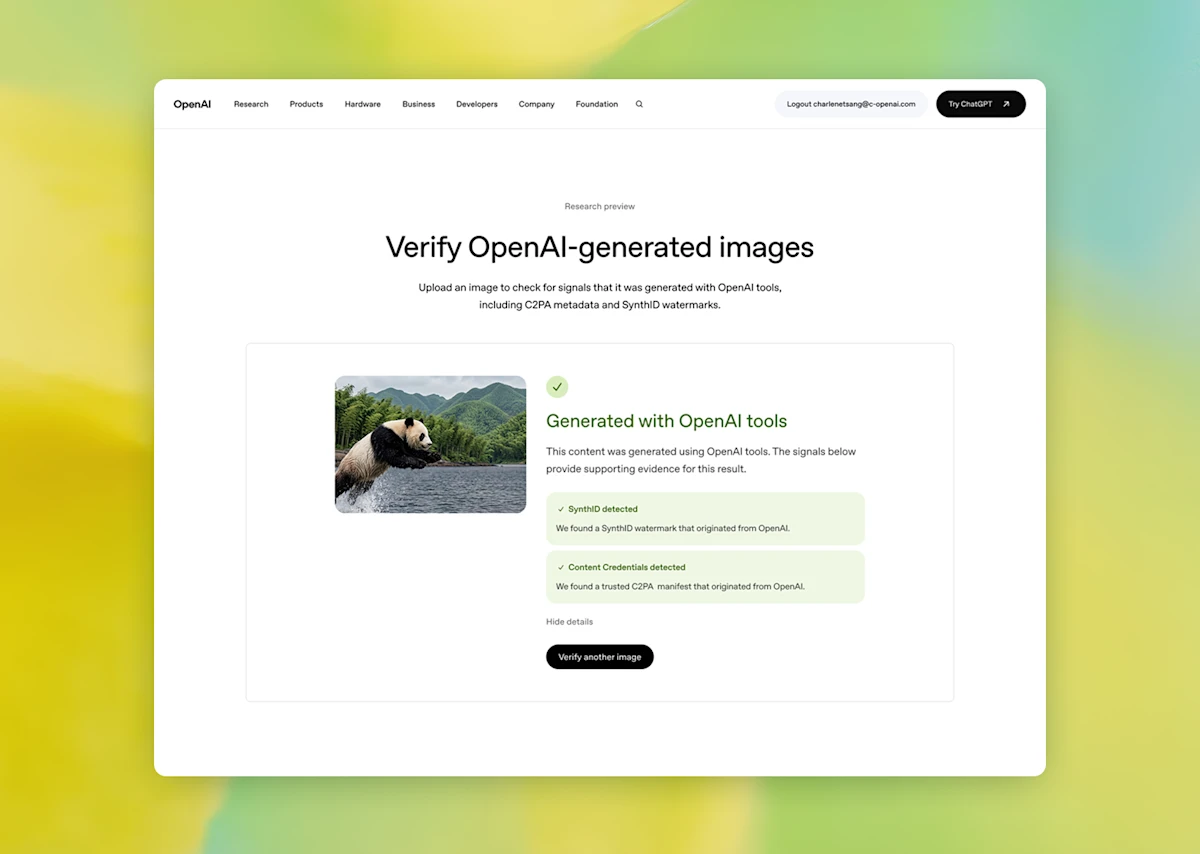
OpenAI's official guide to verifying the origin and authenticity of AI products.
What happened: OpenAI is bringing forward trust and verification efforts to make it easier to confirm the origin and authenticity of products. In addition to the generation speed, the mechanism for identifying what is AI-generated is attracting attention.
Why it matters: A serious risk is that plausible misinformation or doctored images mix with business and political decisions. Provenance verification mechanisms will be needed as quickly as AI spreads.
What to watch: As AI-generated output spreads, authenticity verification may become more important than generation itself. PR, legal, recruiting, credit, and audit workflows are the places to watch.
Cross-sectional view
- With US-China, Iran, Black Sea, and Europe reconnection moving simultaneously, companies need to treat geopolitics as a sourcing condition rather than “news.”
- The combination of the reacceleration of inflation and the Fed’s stability concerns makes it difficult to assume that interest rates will fall soon.
- G7 discussions on correcting imbalances and critical minerals will strengthen the trend toward redundant supply chains rather than cost reductions.
- In terms of technology, the competitive axis is deployment in a corporate environment, SDK, auditing, and authenticity confirmation rather than differences in model performance.
- So the common language of markets and policy today is not “velocity” but “controllability.”
Uncertainty to track
- How far will the US-China agreement go in terms of tariff relief and new trade frameworks?
- Whether Congress’ control of war powers would halt actual military action in the Iranian situation.
- Whether the re-acceleration of CPI and PPI will continue until the June policy meeting.
- How quickly announcements from Google, OpenAI, Anthropic, and NVIDIA will lead to real-world deployments.
- To what extent will the UK-EU reset negotiations reduce the practical burden of food, hygiene, and customs clearance?