Published
-
2026-06-28 Middle East deals, AI rules, and consumer prices move together

2026-06-28 Middle East deals, AI rules, and consumer prices move together
The day’s signal came from three linked pressure points: Middle East diplomacy, U.S. war funding, and AI policy. Israel and Lebanon signed a framework agreement, but implementation still depends on Hezbollah’s role. At the same time, Washington’s Iran-war supplement, the Supreme Court’s asylum ruling, and New York’s Democratic socialist upset kept domestic politics hot, while cheaper gas, sticky travel prices, and AI-driven device costs showed how conflict and computing demand are feeding into household budgets.
Politics
Israel and Lebanon sign framework agreement

The Washington-backed framework moves forward, but Hezbollah remains the main obstacle to implementation.
The bottom line: The deal is a step forward, but it can stall if Hezbollah stays outside the plan.
What happened: Israel and Lebanon signed a framework in Washington that opens a path to withdrawals and redeployments in parts of south Lebanon.
Why it matters: Turning a cease-fire into a lasting settlement will hinge on how the deal handles armed groups and security control.
What to watch: Watch the pilot zones, Hezbollah’s response, and the conditions attached to U.S. support.
Trump asks Congress for $87.6B, mostly for Iran war

The White House asked Congress for an $87.6 billion supplement that leans heavily toward war costs.
The bottom line: Congress now has to decide whether to turn Iran war costs into a budget line.
What happened: The administration asked for an $87.6 billion supplement and signaled heavier spending for defense and related costs.
Why it matters: How Congress treats the war bill will deepen the fight over war powers and oversight.
What to watch: Watch for add-ons or conditions from the House and Senate appropriations panels.
Keir Starmer resigns as U.K. prime minister

A bad local-election showing and internal pressure pushed Labour into a leadership reset.
The bottom line: Labour’s slide has turned leadership turnover into the new center of British politics.
What happened: Starmer resigned after poor local-election results and party pressure, opening the way to a new leadership contest.
Why it matters: Britain now has to rebuild its leadership before it can reset policy under weak growth and external pressure.
What to watch: Watch the leading successors and how quickly Labour shifts its election strategy.
Supreme Court backs Trump on stricter asylum rules

The court upheld the administration's tougher policy toward asylum seekers who have not crossed the border.
The bottom line: The ruling gives the administration more room to tighten southern-border enforcement.
What happened: The Supreme Court allowed Trump’s administration to reject asylum claims from people who have not crossed the border.
Why it matters: The legal footing for tougher screening is stronger, so border capacity matters even more.
What to watch: Watch for operational changes, the next round of lawsuits, and how aid groups respond.
Socialist earthquake in NY leaves Democrats reeling

New York primaries boosted left-wing candidates and exposed a sharper fight over the party's direction.
The bottom line: The New York upset has turned Democratic infighting into a question of strategy.
What happened: Several DSA-backed candidates won, while a few high-profile Democrats lost in upsets.
Why it matters: The party now faces a left-versus-center fight that will shape its 2028 path.
What to watch: Watch the leadership response, follow-on primaries, and national fundraising signals.
Economy
AI price shock hits consumer devices

Higher memory costs are starting to show up in consumer electronics and game hardware prices.
The bottom line: AI spending is starting to reach consumer prices, not just corporate capital budgets.
What happened: Apple and Microsoft moved to raise prices on devices and consoles as memory costs climbed.
Why it matters: The AI boom is now affecting what consumers pay, not just jobs or investment headlines.
What to watch: Watch other device makers, memory prices, and the next round of AI-related price moves.
Gas and airfare prices stay elevated after Iran war
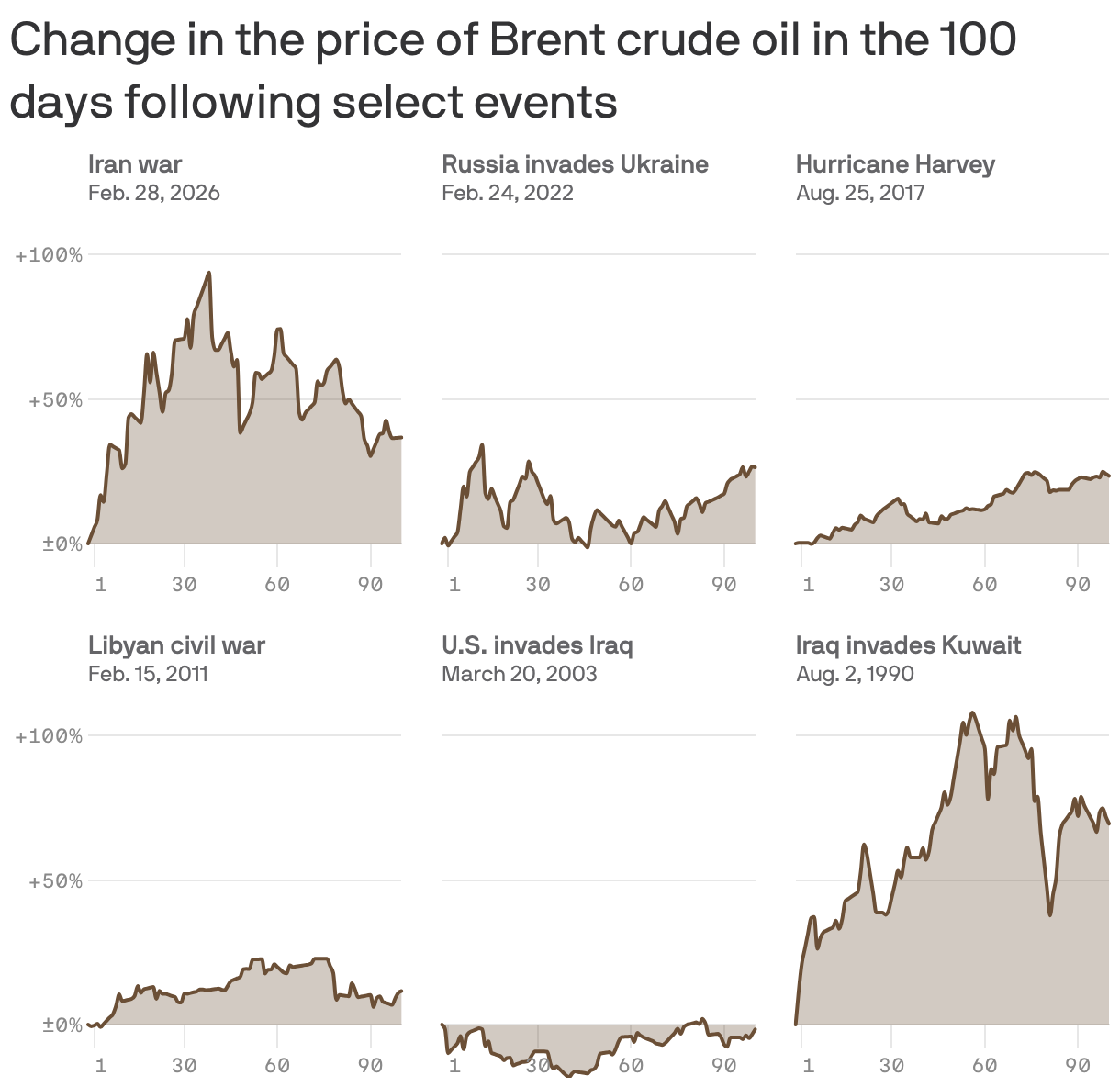
Oil shocks reach gas pumps and airfare with a delay, so relief takes time.
The bottom line: Even if the Iran war cools, gas and airfare will not snap back quickly.
What happened: Oil shocks pass through slowly, so household fuel and travel bills stay high for a while.
Why it matters: Families keep feeling the pinch, and the political backlash lasts longer.
What to watch: Watch crude prices, the national gas average, and airline fare changes.
Cheaper gas lifts consumer sentiment

Lower gas prices helped lift the University of Michigan's June consumer sentiment reading.
The bottom line: Cheaper gas gave household sentiment a modest lift.
What happened: The University of Michigan sentiment index rose in June, with expectations improving more than current conditions.
Why it matters: Even when inflation anger remains, fuel prices still move sentiment faster than most other signals.
What to watch: Watch whether gas stays cheap and whether sentiment keeps recovering.
AI boom is powering the economy

AI infrastructure spending is now lifting the real economy, not just equity prices.
The bottom line: AI spending is starting to act as a growth engine, not just a cost.
What happened: MarketWatch said AI infrastructure spending is boosting GDP and markets while driving more data-center construction.
Why it matters: AI-related spending now ripples into chips, power, construction, and the headline economy.
What to watch: Watch capex growth, profitability, and whether power constraints keep biting.
Stock rally collides with new worries

Investors are rechecking the durability of the rally as AI and rate expectations shift.
The bottom line: The rally continues, but AI and rate worries are starting to split the market.
What happened: The S&P 500 and Nasdaq fell for five straight sessions as investors worried about AI profitability and rates.
Why it matters: Markets are no longer carried by good earnings alone; growth hopes now meet higher funding costs.
What to watch: Watch semiconductor stocks, credit spreads, and shifts in rate-cut bets.
Technology
Anthropic’s Mythos gets limited return

The Commerce Department allowed a limited return for Mythos 5 after Anthropic addressed cybersecurity concerns.
The bottom line: Anthropic won permission, but access is still limited.
What happened: The Commerce Department allowed a limited return of Mythos 5 after Anthropic addressed the earlier security concerns.
Why it matters: Frontier-model access now depends on export controls and safety review as much as performance.
What to watch: Watch the next permission tier, the August cyber EO rollout, and whether Mythos 5 expands.
OpenAI gives GPT-5.5-Cyber more power

OpenAI updated its cyber-focused model to make it stronger and easier to use.
The bottom line: OpenAI pushed its defensive cyber tools up another notch.
What happened: The company refreshed GPT-5.5-Cyber with stronger capabilities and broader usability.
Why it matters: High-end AI is spreading to defenders, but misuse risk rises with it.
What to watch: Watch partner expansion, government deals, and changes to evaluation standards.
Phishing enters automation era

Huntress reported a sharp rise in device-code phishing as attacks became more automated.
The bottom line: Phishing is moving from email drafting to full attack automation.
What happened: Device-code phishing jumped in the first half of 2026, showing how AI and automation are scaling attacks.
Why it matters: Low-skill attack kits are spreading, and criminals are turning harder to stop on authentication tokens.
What to watch: Watch Microsoft auth abuse, the PhaaS market, and how companies harden MFA.
Anthropic and OpenAI join jobs push

States launched a retraining experiment to prepare workers for AI-driven job change.
The bottom line: The AI industry is starting to fund the response to the job shock it creates.
What happened: States and companies launched trials for retraining, wage insurance, and career coaching.
Why it matters: AI job displacement is turning into a practical state-and-company policy problem.
What to watch: Watch the pilot states, wider company participation, and whether retraining leads to new jobs.
Nvidia debuts humanoid robotics safety software

Nvidia introduced safety software for humanoid robots that operate around people.
The bottom line: Humanoid robots are becoming a software and safety contest for Nvidia.
What happened: Nvidia launched a safety system for humanoid robots that work around people.
Why it matters: Getting robots into real workplaces now depends on proving safety as much as capability.
What to watch: Watch early deployments, industrial adoption, and the race over control software.
Cross-cutting read
- Middle East conflict is moving diplomacy and budget fights at the same time.
- AI is starting to shape both market expectations and household costs.
- Court rulings and party realignment are speeding up U.S. political decision-making.
What to watch next
- Whether the Israel-Lebanon framework moves beyond pilot zones.
- Whether Congress trims or expands the Iran supplemental request.
- Whether Anthropic and OpenAI face tighter or looser limits next.