Published
-
Law and Kingship in Ancient Mesopotamia: Reading the Code of Hammurabi
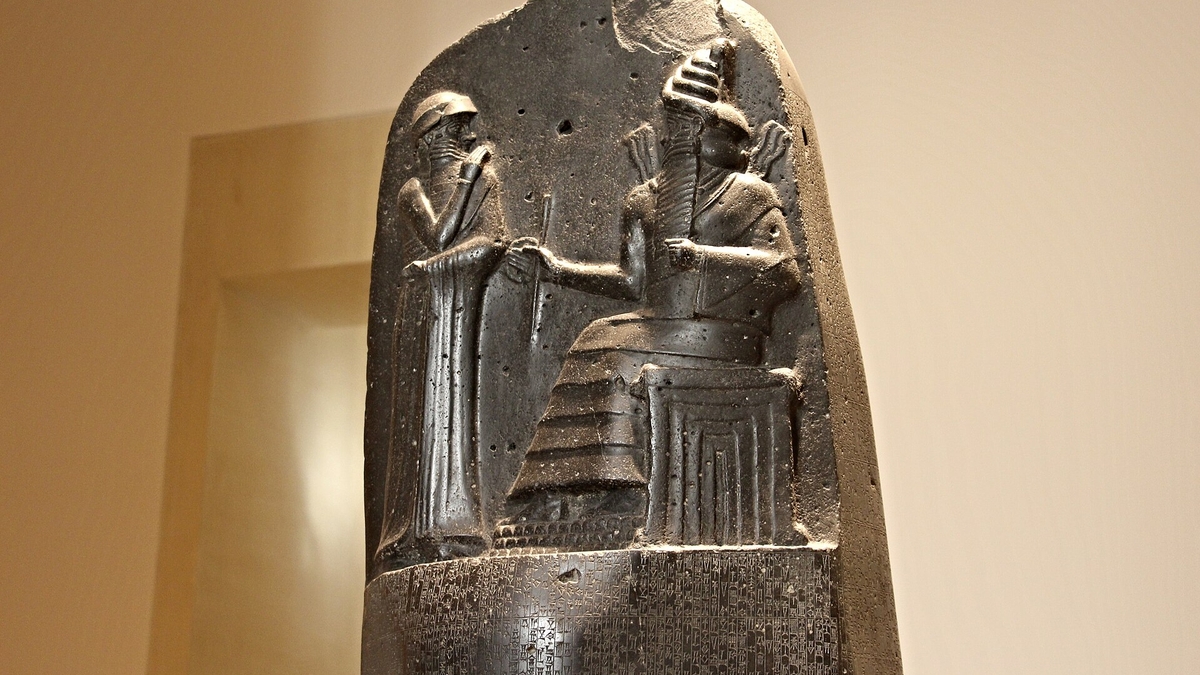
Photo by Mbzt via Wikimedia Commons, CC BY 2.0
1. Executive Summary
The Code of Hammurabi is an Old Babylonian collection of legal judgments associated with King Hammurabi of Babylon in the eighteenth century BCE. The best-known surviving object is a black stone stele more than 2.25 meters high, now held and displayed by the Louvre Museum in Paris. It is enough to note, as a guardrail against confusion, that this is not a religious-classification question and the Code is not connected to Islam or Muhammad. 出典: The Louvre describes the stele as a black stone monument more than 2.25 meters high, engraved around 1750 BCE, with 282 legal judgments. See Louvre, The Code of Hammurabi.
The quickest way to understand it is to treat it as a royal monument of justice. The image at the top presents the king before a god, while the text below covers family, property, trade, labor, and punishments. Divine authority supports the king’s claim to justice, but the text centers on judgments for social disputes rather than worship or doctrine.
This report therefore reads the Code through five concrete examples: a judge’s mistaken written judgment, stolen property and witnesses, debt relief after crop failure, family labor for debt, and status-based bodily injury plus builder liability. These examples show not a modern egalitarian state, but a royal attempt to make social order, proof, contracts, status, compensation, and punishment visible in writing.
       flowchart LR
  A["Ancient Babylon"] --> B["Royal justice"]
  B --> C["Legal judgments"]
  C --> D["Inscribed stele"]
  D --> E["Louvre today"]
2. Royal Law and Divine Imagery
The main religious caution is limited: the Code of Hammurabi should not be read as a scripture of Islam, Christianity, or Judaism, or as a text from the age of Muhammad. Muhammad belongs to the seventh century CE, while the Code of Hammurabi belongs to the eighteenth century BCE, more than two millennia earlier. The main frame is therefore Mesopotamian cities and kingship, not religious classification.
That does not mean the gods are absent from the object. Ancient Mesopotamia was polytheistic, and the relief at the top of the stele is commonly interpreted as Hammurabi standing before Shamash, the sun god and god of justice. In this context, divine imagery helps legitimate the king’s justice. 出典: The Louvre explains the upper relief as Hammurabi before Shamash. See Louvre, The Code of Hammurabi.
3. Which Civilization, and What Other Law Collections?
In the common schoolbook category of ancient river civilizations, the Code belongs to Mesopotamia. More precisely, it is an Old Babylonian text from the world of the Tigris and Euphrates rivers. Hammurabi was a king of the First Dynasty of Babylon and is usually dated to about 1792-1750 BCE. 出典: The Metropolitan Museum of Art places Hammurabi in the Old Babylonian period and dates his reign to about 1792-1750 BCE. See The Met, The Isin-Larsa and Old Babylonian Periods.
This places the Code in the era of ancient urban states, temples, canals, agricultural land, trade, slavery, and royal administration. Rather than reading it through later religious history, it is better understood as a document of Mesopotamian political and legal order.
Nor should the Code of Hammurabi be called simply the first law in human history. Cuneiform law includes earlier and later collections such as the Laws of Ur-Nammu, the Laws of Lipit-Ishtar, the Laws of Eshnunna, the Hittite laws, and the Assyrian laws. Britannica describes cuneiform law as a broader ancient Near Eastern body of law shared by Sumerians, Babylonians, Assyrians, Elamites, Hurrians, Kassites, Hittites, and others, and places Hammurabi’s Code within that wider tradition as a major Babylonian legal monument. 出典: Britannica, cuneiform law summarizes common features of cuneiform law and situates Ur-Nammu, Lipit-Ishtar, Hammurabi, Assyrian law, and Hittite law. For source metadata on the Laws of Ur-Nammu, see CDLI, Ur-Nammu Law Code.
| Law collection or text | Approximate period | How to read it |
|---|---|---|
| Laws of Ur-Nammu | Twenty-first century BCE | An earlier Sumerian collection; bodily injury can lead to monetary compensation |
| Laws of Lipit-Ishtar | Early twentieth century BCE | A collection with prologue, laws, and epilogue, covering family and property |
| Laws of Eshnunna | Around the twentieth century BCE | Rules on silver, grain, prices, injury, and ox-related accidents |
| Code of Hammurabi | Eighteenth century BCE | A large stele preserving 282 case-like judgments |
| Hittite and Assyrian laws | Later second millennium BCE | Later regional collections with different social and penal emphases |
4. How Was a “Code” Treated Then?
The Code is often called a law code, but it is not a modern statute book. The Louvre describes it more carefully as a broad collection of jurisprudence or case law, organized around areas such as family, property, trade, and labor. The famous formula “an eye for an eye” represents one part of this legal imagination, not the whole document. 出典: The Louvre cautions that the text is not a legal code in the modern sense. English translations of individual provisions can be checked through Yale Law School Avalon Project, The Code of Hammurabi.
It should also not be mistaken for a modern egalitarian legal order. The rules differentiate by status, gender, and enslavement. Punishments can be severe. The historically important point is that the king publicized an ordered model of justice across many areas of life.
An ancient “code” was not a modern statute enacted by a legislature, published in an official gazette, and cited by courts as controlling legislation. Many such texts include royal prologues and epilogues that present kingship, divine authorization, weak-person protection, and restored order. The rules are written as “if A, then B” conditional cases rather than abstract rights. The Louvre likewise explains that Hammurabi’s laws follow an if-clause and then-clause structure. 出典: The conditional format is based on Louvre, The Code of Hammurabi. The distinction between cuneiform law collections and modern systematic codes is based on Britannica, cuneiform law.
So the Code should be read in three layers. First, it is a political monument. Second, it is part of scribal and scholarly textual culture. Third, it stands beside actual court practice, contracts, legal customs, and royal decrees. The text alone does not prove that every court case was decided exactly this way, but it shows how the king wanted ideal judgment and social order to be imagined.
| Misunderstanding | Better Reading |
|---|---|
| It is an Islamic legal text | It predates Islam by more than two thousand years |
| It should be read by religious classification | It has divine imagery, but its center is royal legal judgment |
| It is modern law | It reflects an ancient stratified society |
| It is the oldest law ever | Older legal collections exist, but this one is unusually famous and well preserved |
5. Five Concrete Examples from the Laws
Concrete examples show that the Code is not just a list of harsh punishments. It also deals with proof, contracts, agricultural risk, family, status, and professional responsibility. The short quotations below come from the L. W. King translation hosted by the Yale Avalon Project, and law numbers follow that translation.
| Example | Short quotation | Application and interpretation |
|---|---|---|
| A judge’s mistaken judgment | Law 5, “judgment in writing” | If a judge issues a written decision and later error is shown to be his own fault, he pays a heavy penalty and is removed from the bench. This suggests that judging was tied to written decisions, office, and public responsibility, not only oral discretion. 出典: Law 5 says that a judge whose written judgment is later shown erroneous through his own fault must pay twelve times the fine and be removed from the judge’s bench. See Yale Avalon, Code of Hammurabi, law 5. |
| Stolen goods and witnesses | Law 7, “witnesses or a contract” | Buying silver, gold, enslaved persons, livestock, or other goods without witnesses or a contract makes the buyer a thief. Transactions depended on witnesses, contract tablets, and identification of property. 出典: Laws 7-12 deal with purchases, lost property, witnesses, identification, and merchant liability. See Yale Avalon, Code of Hammurabi, laws 7-12. |
| Debt relief after disaster | Law 48, “storm” | If a debtor’s field is ruined by storm, crop failure, or lack of water, he need not repay grain that year and washes the debt tablet in water. Agricultural risk was not always pushed entirely onto the debtor. 出典: Law 48 covers storm, failed harvest, and lack of water, and provides for nonpayment of grain that year. See Yale Avalon, Code of Hammurabi, law 48. |
| Family labor for debt | Law 117, “three years” | A debtor may give his wife, son, or daughter to labor for a creditor, but the term is limited to three years, with release in the fourth. This is not modern freedom of contract, but it is also not unlimited detention. 出典: Law 117 limits this debt labor to three years and release in the fourth year. See Yale Avalon, Code of Hammurabi, law 117. |
| Status-based injury and builders | Law 196, “eye”; Law 229, “builder” | Bodily injury rules change with the victim’s status: equal-status injury can trigger talion, while injury to a freedman or slave produces monetary compensation. Builder liability is also severe: if a poorly built house collapses and kills the owner, the builder is killed; if it kills the owner’s son, the builder’s son is killed. 出典: Laws 196-199 distinguish eye and bone injuries by status; laws 229-233 address collapse, death, compensation, and rebuilding. See Yale Avalon, Code of Hammurabi, laws 196-199 and 229-233. The Louvre discusses law 196 as an example of proportional punishment and lex talionis. |
These five examples show the Code turning typical urban disputes into the language of royal justice. They also show clear distance from modern law: status hierarchy and family substitution are built into the reasoning. The historical value lies partly in that distance, because it lets us see how social order was made concrete in Old Babylonian legal imagination.
6. Does the Object Still Exist?
Yes. The most famous surviving object is the stele in the Louvre. It was created in a Babylonian context, later taken to Susa, and found there in the early twentieth century in present-day Iran. 出典: Encyclopaedia Iranica notes that the Code of Hammurabi was found at Susa in three pieces in January 1902. See Encyclopaedia Iranica, Susa i. Excavations.
The question of how many copies exist has two answers. As a museum object, the famous Louvre stele is the central surviving monument. As a text, however, the laws circulated through ancient copying and later manuscript fragments. So “the real Code of Hammurabi” usually refers to the Louvre stele, while the textual tradition is broader than one stone.
7. Why It Matters
The Code is famous not only because it is old, but because it joins kingship, divine imagery, writing, law, hierarchy, trade, and family life in one monument. It is a powerful example of an ancient state explaining itself through written order.
It also makes ancient society legible as a world of concrete disputes. The text deals with fields, labor, property, marriage, inheritance, injury, debt, and punishment. That makes it useful not as a model to imitate, but as evidence for how an ancient state imagined justice and social hierarchy.
8. Beginner’s Conclusion
The Code of Hammurabi is an Old Babylonian legal monument from about 3,800 years ago. It is not a religious scripture, and it is not connected to Muhammad or Islam. It belongs to Mesopotamian civilization, and its best-known surviving object is the stele now in the Louvre Museum.
The one-sentence version is this: the Code of Hammurabi is a Mesopotamian legal monument in which the Babylonian king Hammurabi presented royal justice as written rules for disputes in ancient urban society.
A deeper reading should also avoid being trapped by the word “code.” The object is less a direct ancestor of a modern civil code than a monument that joins royal legitimacy, scribal culture, typical cases, social hierarchy, and professional responsibility in one written image of ancient urban order.
References
1. エグゼクティブサマリー
ハンムラビ法典は、紀元前18世紀ごろのバビロン王ハンムラビの名で伝わる、古代メソポタミアの法判断集である。現在もっとも有名な実物は、高さ2.25メートルを超える黒い石碑で、パリのルーヴル美術館に収蔵・展示されている。宗教分類で読む資料ではなく、イスラム教やムハンマドと直接関係しない点は、誤解防止の注意として押さえればよい。 出典: ルーヴル美術館は、石碑を高さ2.25メートル超の黒い石碑と説明し、本文を紀元前1750年ごろに刻まれた282件の法判断集として紹介している。Louvre, The Code of Hammurabi を参照。
この法典を理解する近道は、「王が正義を示すための記念碑」として見ることだ。上部には王が神の前に立つ図像があり、本文には家族、財産、商取引、労働、刑罰などの事例型ルールが刻まれている。神の権威は王権を支えるが、本文の中心は礼拝や教義ではなく、社会の揉めごとへの判断である。
本稿では、法典の性格を抽象的に説明するだけでなく、裁判官の誤判、盗品売買、災害時の債務、家族の債務労働、身分別の身体被害と建築責任という5つの具体例から読む。そこに見えるのは、現代的な平等な法治国家ではなく、王が社会秩序、証拠、契約、身分、賠償、刑罰をどのように可視化したかである。
       flowchart LR
  A["古代バビロン"] --> B["王の正義"]
  B --> C["法判断集"]
  C --> D["石碑に刻む"]
  D --> E["ルーヴル所蔵"]
2. 王権の法記念碑と神の図像
宗教との関係で必要な注意は、ハンムラビ法典をイスラム教、キリスト教、ユダヤ教の聖典として読まないこと、また預言者ムハンマドの時代の文書として読まないことである。ムハンマドは西暦7世紀の人物であり、ハンムラビ法典はその約2300年以上前に属する。したがって、主題は宗教分類ではなく、「メソポタミアの都市国家と王権の歴史」である。
ただし、神と無関係という意味ではない。古代メソポタミアは多神教の世界であり、石碑上部にはハンムラビが太陽神・正義神シャマシュの前に立つ場面と解釈される浮彫がある。ここでの神の図像は、王が神々の秩序に支えられて正義を行うという政治的正統化として理解できる。 出典: ルーヴルは、上部の浮彫をシャマシュの前に立つハンムラビとして説明している。Louvre, The Code of Hammurabi を参照。
3. どの文明の時代か、他にどんな法集があったか
日本の教科書的な言い方を使えば、ハンムラビ法典は「四大文明」のうちメソポタミア文明に属する。より具体的には、チグリス川・ユーフラテス川流域で発展した古代近東世界の、古バビロニア時代の資料である。ハンムラビは第1バビロン王朝の王で、バビロンをメソポタミア南部の有力な政治中心へ押し上げた人物として説明される。 出典: Metropolitan Museum of Artは、ハンムラビを紀元前1792年ごろから1750年ごろのバビロン王として位置づけ、古バビロニア期の政治拡大を説明している。The Met, The Isin-Larsa and Old Babylonian Periods を参照。
この時代は、エジプト、インダス、中国古代文明と並べて語られる「古代文明」の時代である。後世の宗教史と重ねるより、都市、農地、神殿、商取引、奴隷制、家族制度を持つ古代都市社会の法資料として捉える方がよい。
また、ハンムラビ法典は「人類最初の法律」と単純に言い切る対象でもない。楔形文字法には、ウル・ナンム法典、リピト・イシュタル法典、エシュヌンナ法、ヒッタイト法、アッシリア法など、前後の法集がある。Britannicaは楔形文字法を、シュメール人、バビロニア人、アッシリア人、エラム人、フルリ人、カッシート人、ヒッタイト人などが共有した古代近東の法文書群として整理し、ハンムラビ法典をその中でも特に完成度の高いバビロニア法の記念碑として位置づけている。 出典: Britannica, cuneiform law は、楔形文字法の共通特徴、ウル・ナンム、リピト・イシュタル、ハンムラビ、アッシリア法、ヒッタイト法の位置づけを整理している。ウル・ナンム法典の資料情報は CDLI, Ur-Nammu Law Code も参照した。
| 法集・法文書 | おおよその時期 | 読み方のポイント |
|---|---|---|
| ウル・ナンム法典 | 紀元前21世紀ごろ | ハンムラビより古いシュメール語系の法集。身体被害に金銭賠償が見える |
| リピト・イシュタル法典 | 紀元前20世紀前半 | 序文・条文・結語を持ち、婚姻・相続・財産・契約などを扱う |
| エシュヌンナ法 | 紀元前20世紀前後 | 銀や穀物での賠償、価格、身体被害、牛の事故などを扱う |
| ハンムラビ法典 | 紀元前18世紀ごろ | 石碑として保存され、282件の事例型判断を大規模に示す |
| ヒッタイト法・アッシリア法 | 紀元前2千年紀後半以降 | 地域や社会構造の違いを反映し、賠償や家族・身分秩序の扱いが異なる |
4. 当時「法典」はどう扱われたのか
現代の意味での完全な法律コードというより、事例に応じた法判断を集めた文書と見るのが正確である。ルーヴルは、これを近代的な「法典」そのものではなく、家族、財産、取引、労働などに関する広い法判断集として説明している。よく知られる「目には目を、歯には歯を」は、同害報復の原理を示す一部として有名になった表現である。 出典: ルーヴルは、ハンムラビ法典を近代的な意味での法典ではなく判例・法判断の集合として説明している。Louvre, The Code of Hammurabi を参照。条文例の英訳は Yale Law School Avalon Project, The Code of Hammurabi で確認できる。
ただし、そこから「古代人は平等な法治主義を完成させていた」と考えるのは早い。条文は身分、性別、自由人か奴隷かによって扱いを変える。刑罰はしばしば苛烈で、身体刑や死刑も含む。重要なのは、現代の人権規範と同じかどうかではなく、王が社会秩序をどのように文章化し、可視化しようとしたかである。
古代の「法典」は、議会が制定して官報に載せ、裁判所が条文番号を引用して適用する近代法典とは違う。多くは王の序文や結語を伴い、神から与えられた王権、弱者保護、秩序回復を語る。条文は「もしAなら、Bする」という条件文で書かれ、抽象的な権利論よりも、典型的な争い方を並べる。ルーヴルも、ハンムラビ法典の条文が「if」で始まる条件部と、処理や刑罰を示す後半部から成ると説明している。 出典: 条件文形式は Louvre, The Code of Hammurabi の説明に基づく。楔形文字法の法集が近代法典のように体系的な全規則を扱うのではなく、個別事例を例示するという整理は Britannica, cuneiform law を参照した。
そのため、ハンムラビ法典を読むときは、三つの層を分ける必要がある。第一に、石碑としての政治的メッセージである。第二に、書記や知識人が学び、写し、保存した文章文化である。第三に、実際の裁判や契約で使われた慣習法・証拠文書・王令との関係である。本文だけを見て「当時の全裁判が必ずこの通りだった」とは言えないが、王がどのような秩序を理想的判断として示したかはよく分かる。
| 誤解 | 整理 |
|---|---|
| イスラム教の法典 | イスラム成立より約2300年以上前の古バビロニア資料 |
| 宗教分類で読む資料 | 神の図像を伴うが、中心は王権・法判断の記念碑 |
| 現代法と同じ | 身分差・身体刑を含む古代都市社会の規範 |
| 世界最古の法律 | より古い法集もあるが、保存状態と規模が特に有名 |
5. 条文から見る具体例
具体例を見ると、ハンムラビ法典が単なる残酷刑のリストではなく、証拠、契約、農業リスク、家族、身分、職業責任を扱う都市社会の資料であることが分かる。以下の引用は、Yale Avalon Project掲載のL. W. King英訳から短く引いたもので、条文番号は同訳の番号に従う。
| 具体例 | 条文の短い引用 | 適用場面・読み方 |
|---|---|---|
| 裁判官の誤判 | 第5条「judgment in writing」 | 判決を文書化した裁判官が後で自分の過失による誤判を示した場合、重い賠償と罷免を受ける。裁判が口頭の恣意だけでなく、書面・席次・公的責任と結びついていたことを示す。 出典: 第5条は、裁判官が判決を文書にして後に過失が判明した場合、定めた罰金の12倍を支払い、裁判官席から外されるとする。Yale Avalon, Code of Hammurabi, law 5 を参照。 |
| 盗品売買と証人 | 第7条「witnesses or a contract」 | 銀、金、奴隷、家畜などを証人や契約なしに買うと盗人とみなされる。古代の取引が信用だけでなく、証人、契約板、所有物識別に依存していたことが分かる。 出典: 第7条から第12条は、盗品売買、証人、所有物の識別、商人の責任を連続して扱う。Yale Avalon, Code of Hammurabi, laws 7-12 を参照。 |
| 災害時の債務猶予 | 第48条「storm」 | 借金をしている農民の畑が嵐、収穫不良、水不足に遭った年は、穀物を返さず債務板を水で洗うとされる。農業社会では、自然災害リスクを債務者だけに負わせない発想があった。 出典: 第48条は、嵐、収穫不良、水不足の年に穀物返済を免れ、債務板を水で洗うとする。Yale Avalon, Code of Hammurabi, law 48 を参照。 |
| 債務による家族労働 | 第117条「three years」 | 債務のために妻、息子、娘を労働に出す場合、3年働き、4年目に解放されるとされる。これは現代の人身売買禁止とは異なるが、無期限の拘束ではなく年限を置く規則として読める。 出典: 第117条は、債務のために妻・息子・娘を労働に出す場合、3年間働き4年目に解放されるとする。Yale Avalon, Code of Hammurabi, law 117 を参照。 |
| 身分別の身体被害と建築責任 | 第196条「eye」、第229条「builder」 | 同じ身体被害でも、相手が同等身分、解放民、奴隷かで刑罰や賠償が変わる。家が崩れて所有者が死ねば建築者が死刑、所有者の息子が死ねば建築者の息子が死刑とされ、責任追及は厳しいが、現代の個人責任原則とは大きく異なる。 出典: 第196-199条は目や骨の被害を身分別に扱い、第229-233条は建築不良による死亡・損害・再建責任を扱う。Yale Avalon, Code of Hammurabi, laws 196-199 and 229-233 を参照。ルーヴルは第196条を、比例的な処罰を示すlex talionisの例として説明している。 |
この5例から見えるのは、法典が「抽象的な倫理書」ではなく、都市社会の典型的な揉めごとを王の正義の言葉に変換した資料だということである。同時に、身分差や家族成員への連座は明確であり、現代法の価値観にそのまま接続できない。古代法として読む価値は、そこにある距離も含めて、当時の社会秩序を具体的に見せる点にある。
6. 実物は存在するのか
存在する。もっとも有名な実物は、ルーヴル美術館の近東古代部門にある石碑である。石碑はもともとバビロニアの文脈で作られたが、後世にエラム側へ運ばれたと考えられ、20世紀初頭にスーサ、現在のイランで発見された。 出典: Encyclopaedia Iranicaは、スーサ発掘でハンムラビ法典が1902年1月に三つの部分として発見されたことを整理している。Encyclopaedia Iranica, Susa i. Excavations を参照。
「いくつあるのか」という問いには、二つの答えがある。第一に、ルーヴルにある有名な石碑としては一基である。第二に、本文そのものは古代の書記教育や写本文化の中で写され、断片や写しが複数知られている。したがって、観光や博物館で見る「ハンムラビ法典の実物」といえばルーヴルの石碑を指すことが多いが、文献としての伝承は石碑一基だけに閉じていない。
7. なぜ有名なのか
ハンムラビ法典が有名なのは、単に古いからではない。王権、神の図像、法律、社会階層、商取引、家族制度が、一つの大きな記念碑にまとめて刻まれているからである。文字で統治を可視化するという意味で、古代国家の自己説明として非常に強い資料である。
もう一つの理由は、法が「王の気分」だけでなく、社会のさまざまな場面に適用されるルールとして示されている点にある。もちろん、現代の法の支配とは違う。だが、農地、雇用、売買、婚姻、相続、損害賠償、刑罰のような具体的生活領域を扱うため、読者は古代社会を抽象的な「文明」ではなく、揉めごとを抱える人間社会として想像できる。
8. 初学者向けの結論
ハンムラビ法典は、古代メソポタミアの王が社会秩序を示した法判断の記念碑である。宗教上の経典ではなく、イスラム教やムハンマドとも直接関係しない。時代は紀元前18世紀ごろ、場所はバビロンを中心とするメソポタミア、実物の代表は現在ルーヴル美術館にある石碑である。
最初に覚えるなら、次の一文でよい。ハンムラビ法典とは、約3800年前のバビロン王ハンムラビが、王の正義として社会の揉めごとへの判断を石に刻ませた古代メソポタミアの法資料である。
もう少し深く読むなら、「法典」という名前に引っ張られすぎないことが重要である。それは近代法典の祖型というより、王の正統性、書記文化、典型事例、社会階層、職業責任を一つの石碑にまとめた、古代都市社会の自己説明である。