Published
-
Law and Kingship in Ancient Mesopotamia: Reading the Code of Hammurabi
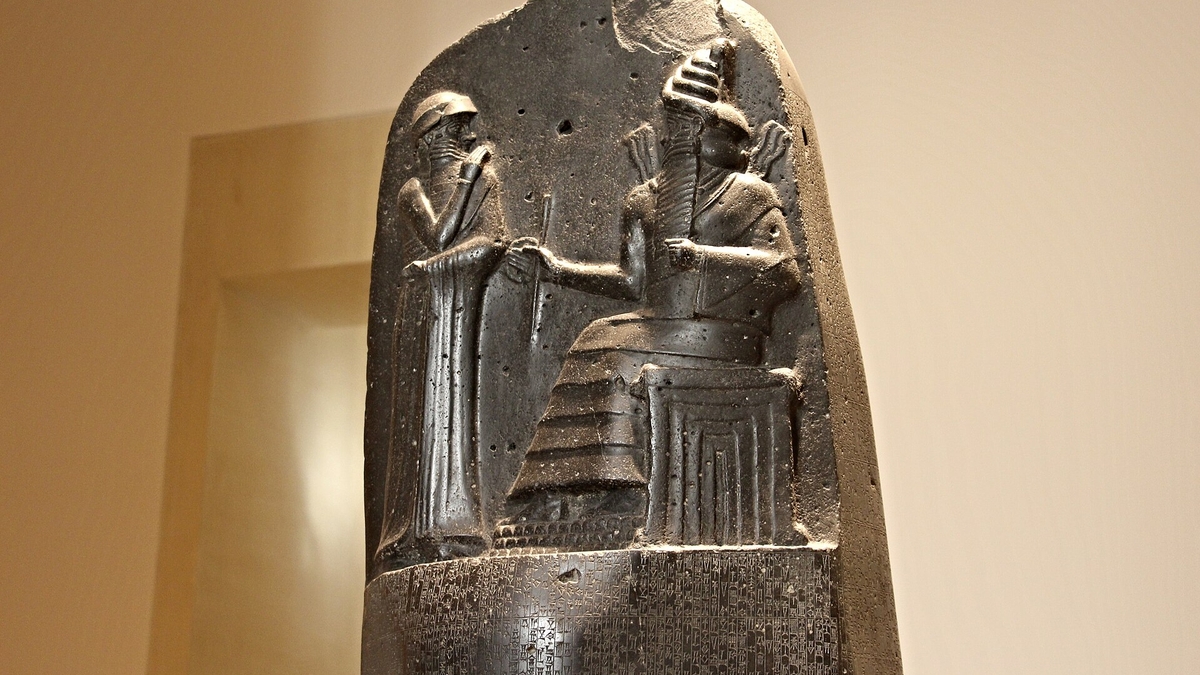
Photo by Mbzt via Wikimedia Commons, CC BY 2.0
1. Executive Summary
The Code of Hammurabi is an Old Babylonian collection of legal judgments associated with King Hammurabi of Babylon in the eighteenth century BCE. The best-known surviving object is a black stone stele more than 2.25 meters high, now held and displayed by the Louvre Museum in Paris. It is enough to note, as a guardrail against confusion, that this is not a religious-classification question and the Code is not connected to Islam or Muhammad. Source: The Louvre describes the stele as a black stone monument more than 2.25 meters high, engraved around 1750 BCE, with 282 legal judgments. See Louvre, The Code of Hammurabi.
The quickest way to understand it is to treat it as a royal monument of justice. The image at the top presents the king before a god, while the text below covers family, property, trade, labor, and punishments. Divine authority supports the king’s claim to justice, but the text centers on judgments for social disputes rather than worship or doctrine.
This report therefore reads the Code through five concrete examples: a judge’s mistaken written judgment, stolen property and witnesses, debt relief after crop failure, family labor for debt, and status-based bodily injury plus builder liability. These examples show not a modern egalitarian state, but a royal attempt to make social order, proof, contracts, status, compensation, and punishment visible in writing.
       flowchart LR
  A["Ancient Babylon"] --> B["Royal justice"]
  B --> C["Legal judgments"]
  C --> D["Inscribed stele"]
  D --> E["Louvre today"]
2. Royal Law and Divine Imagery
The main religious caution is limited: the Code of Hammurabi should not be read as a scripture of Islam, Christianity, or Judaism, or as a text from the age of Muhammad. Muhammad belongs to the seventh century CE, while the Code of Hammurabi belongs to the eighteenth century BCE, more than two millennia earlier. The main frame is therefore Mesopotamian cities and kingship, not religious classification.
That does not mean the gods are absent from the object. Ancient Mesopotamia was polytheistic, and the relief at the top of the stele is commonly interpreted as Hammurabi standing before Shamash, the sun god and god of justice. In this context, divine imagery helps legitimate the king’s justice. Source: The Louvre explains the upper relief as Hammurabi before Shamash. See Louvre, The Code of Hammurabi.
3. Which Civilization, and What Other Law Collections?
In the common schoolbook category of ancient river civilizations, the Code belongs to Mesopotamia. More precisely, it is an Old Babylonian text from the world of the Tigris and Euphrates rivers. Hammurabi was a king of the First Dynasty of Babylon and is usually dated to about 1792-1750 BCE. Source: The Metropolitan Museum of Art places Hammurabi in the Old Babylonian period and dates his reign to about 1792-1750 BCE. See The Met, The Isin-Larsa and Old Babylonian Periods.
This places the Code in the era of ancient urban states, temples, canals, agricultural land, trade, slavery, and royal administration. Rather than reading it through later religious history, it is better understood as a document of Mesopotamian political and legal order.
Nor should the Code of Hammurabi be called simply the first law in human history. Cuneiform law includes earlier and later collections such as the Laws of Ur-Nammu, the Laws of Lipit-Ishtar, the Laws of Eshnunna, the Hittite laws, and the Assyrian laws. Britannica describes cuneiform law as a broader ancient Near Eastern body of law shared by Sumerians, Babylonians, Assyrians, Elamites, Hurrians, Kassites, Hittites, and others, and places Hammurabi’s Code within that wider tradition as a major Babylonian legal monument. Source: Britannica, cuneiform law summarizes common features of cuneiform law and situates Ur-Nammu, Lipit-Ishtar, Hammurabi, Assyrian law, and Hittite law. For source metadata on the Laws of Ur-Nammu, see CDLI, Ur-Nammu Law Code.
| Law collection or text | Approximate period | How to read it |
|---|---|---|
| Laws of Ur-Nammu | Twenty-first century BCE | An earlier Sumerian collection; bodily injury can lead to monetary compensation |
| Laws of Lipit-Ishtar | Early twentieth century BCE | A collection with prologue, laws, and epilogue, covering family and property |
| Laws of Eshnunna | Around the twentieth century BCE | Rules on silver, grain, prices, injury, and ox-related accidents |
| Code of Hammurabi | Eighteenth century BCE | A large stele preserving 282 case-like judgments |
| Hittite and Assyrian laws | Later second millennium BCE | Later regional collections with different social and penal emphases |
4. How Was a “Code” Treated Then?
The Code is often called a law code, but it is not a modern statute book. The Louvre describes it more carefully as a broad collection of jurisprudence or case law, organized around areas such as family, property, trade, and labor. The famous formula “an eye for an eye” represents one part of this legal imagination, not the whole document. Source: The Louvre cautions that the text is not a legal code in the modern sense. English translations of individual provisions can be checked through Yale Law School Avalon Project, The Code of Hammurabi.
It should also not be mistaken for a modern egalitarian legal order. The rules differentiate by status, gender, and enslavement. Punishments can be severe. The historically important point is that the king publicized an ordered model of justice across many areas of life.
An ancient “code” was not a modern statute enacted by a legislature, published in an official gazette, and cited by courts as controlling legislation. Many such texts include royal prologues and epilogues that present kingship, divine authorization, weak-person protection, and restored order. The rules are written as “if A, then B” conditional cases rather than abstract rights. The Louvre likewise explains that Hammurabi’s laws follow an if-clause and then-clause structure. Source: The conditional format is based on Louvre, The Code of Hammurabi. The distinction between cuneiform law collections and modern systematic codes is based on Britannica, cuneiform law.
So the Code should be read in three layers. First, it is a political monument. Second, it is part of scribal and scholarly textual culture. Third, it stands beside actual court practice, contracts, legal customs, and royal decrees. The text alone does not prove that every court case was decided exactly this way, but it shows how the king wanted ideal judgment and social order to be imagined.
| Misunderstanding | Better Reading |
|---|---|
| It is an Islamic legal text | It predates Islam by more than two thousand years |
| It should be read by religious classification | It has divine imagery, but its center is royal legal judgment |
| It is modern law | It reflects an ancient stratified society |
| It is the oldest law ever | Older legal collections exist, but this one is unusually famous and well preserved |
5. Five Concrete Examples from the Laws
Concrete examples show that the Code is not just a list of harsh punishments. It also deals with proof, contracts, agricultural risk, family, status, and professional responsibility. The short quotations below come from the L. W. King translation hosted by the Yale Avalon Project, and law numbers follow that translation.
| Example | Short quotation | Application and interpretation |
|---|---|---|
| A judge’s mistaken judgment | Law 5, “judgment in writing” | If a judge issues a written decision and later error is shown to be his own fault, he pays a heavy penalty and is removed from the bench. This suggests that judging was tied to written decisions, office, and public responsibility, not only oral discretion. Source: Law 5 says that a judge whose written judgment is later shown erroneous through his own fault must pay twelve times the fine and be removed from the judge’s bench. See Yale Avalon, Code of Hammurabi, law 5. |
| Stolen goods and witnesses | Law 7, “witnesses or a contract” | Buying silver, gold, enslaved persons, livestock, or other goods without witnesses or a contract makes the buyer a thief. Transactions depended on witnesses, contract tablets, and identification of property. Source: Laws 7-12 deal with purchases, lost property, witnesses, identification, and merchant liability. See Yale Avalon, Code of Hammurabi, laws 7-12. |
| Debt relief after disaster | Law 48, “storm” | If a debtor’s field is ruined by storm, crop failure, or lack of water, he need not repay grain that year and washes the debt tablet in water. Agricultural risk was not always pushed entirely onto the debtor. Source: Law 48 covers storm, failed harvest, and lack of water, and provides for nonpayment of grain that year. See Yale Avalon, Code of Hammurabi, law 48. |
| Family labor for debt | Law 117, “three years” | A debtor may give his wife, son, or daughter to labor for a creditor, but the term is limited to three years, with release in the fourth. This is not modern freedom of contract, but it is also not unlimited detention. Source: Law 117 limits this debt labor to three years and release in the fourth year. See Yale Avalon, Code of Hammurabi, law 117. |
| Status-based injury and builders | Law 196, “eye”; Law 229, “builder” | Bodily injury rules change with the victim’s status: equal-status injury can trigger talion, while injury to a freedman or slave produces monetary compensation. Builder liability is also severe: if a poorly built house collapses and kills the owner, the builder is killed; if it kills the owner’s son, the builder’s son is killed. Source: Laws 196-199 distinguish eye and bone injuries by status; laws 229-233 address collapse, death, compensation, and rebuilding. See Yale Avalon, Code of Hammurabi, laws 196-199 and 229-233. The Louvre discusses law 196 as an example of proportional punishment and lex talionis. |
These five examples show the Code turning typical urban disputes into the language of royal justice. They also show clear distance from modern law: status hierarchy and family substitution are built into the reasoning. The historical value lies partly in that distance, because it lets us see how social order was made concrete in Old Babylonian legal imagination.
6. Does the Object Still Exist?
Yes. The most famous surviving object is the stele in the Louvre. It was created in a Babylonian context, later taken to Susa, and found there in the early twentieth century in present-day Iran. Source: Encyclopaedia Iranica notes that the Code of Hammurabi was found at Susa in three pieces in January 1902. See Encyclopaedia Iranica, Susa i. Excavations.
The question of how many copies exist has two answers. As a museum object, the famous Louvre stele is the central surviving monument. As a text, however, the laws circulated through ancient copying and later manuscript fragments. So “the real Code of Hammurabi” usually refers to the Louvre stele, while the textual tradition is broader than one stone.
7. Why It Matters
The Code is famous not only because it is old, but because it joins kingship, divine imagery, writing, law, hierarchy, trade, and family life in one monument. It is a powerful example of an ancient state explaining itself through written order.
It also makes ancient society legible as a world of concrete disputes. The text deals with fields, labor, property, marriage, inheritance, injury, debt, and punishment. That makes it useful not as a model to imitate, but as evidence for how an ancient state imagined justice and social hierarchy.
8. Beginner’s Conclusion
The Code of Hammurabi is an Old Babylonian legal monument from about 3,800 years ago. It is not a religious scripture, and it is not connected to Muhammad or Islam. It belongs to Mesopotamian civilization, and its best-known surviving object is the stele now in the Louvre Museum.
The one-sentence version is this: the Code of Hammurabi is a Mesopotamian legal monument in which the Babylonian king Hammurabi presented royal justice as written rules for disputes in ancient urban society.
A deeper reading should also avoid being trapped by the word “code.” The object is less a direct ancestor of a modern civil code than a monument that joins royal legitimacy, scribal culture, typical cases, social hierarchy, and professional responsibility in one written image of ancient urban order.